
Where the Crossing Begins
You feel it before you fully understand what's happening.
The ship has slipped between concrete walls. The rainforest that stretched wide around you only moments ago has narrowed into a corridor, and somewhere behind you, a pair of enormous gates begins to close.
Then, almost imperceptibly, you start to rise.
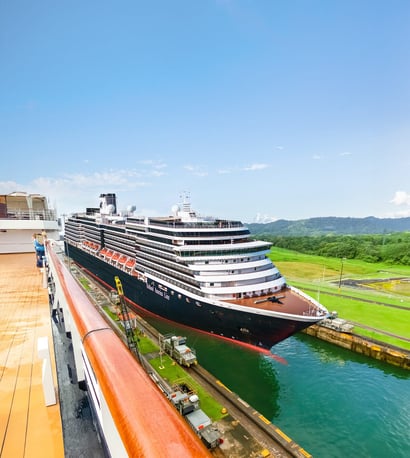
The water climbs and the walls seem to sink. A ship that felt enormous at sea is suddenly being lifted, slowly and deliberately, until you are 85 feet above the ocean you sailed in on.
This is the Panama Canal.
And for all the photographs, documentaries, and history lessons devoted to it, there is still no substitute for standing on deck as your ship rises above one ocean before descending into another.
The Journey Is the Destination
Most trips are built around arrival. You fly to Paris for Paris, or you cross the Atlantic to reach Europe. Even on a cruise, the days at sea often exist to carry you from one port to the next.
The Panama Canal changes that equation entirely.
Here, the passage itself is the reason you came. For eight to ten hours, the landscape and the machinery work together around you.
You pass through three sets of locks: Gatún, Pedro Miguel, and Miraflores. The walls drift closer until it seems impossible a ship this size could fit.
Then the water begins to move beneath you. The ship climbs, the gates swing open, and another chamber waits ahead.
Eventually, the canal opens into Gatún Lake. Rainforest spills to the water's edge, and scattered islands reveal the highest points of a valley long since flooded to create the lake.
Hours later, the process reverses. Lock by lock, the ship begins its descent until another ocean waits on the other side. From the railing, you watch the entire story unfold, tracing the same route that transformed global trade more than a century ago.
It's history happening at roughly the speed of a very long, very good morning on deck.
Why Holland America Belongs Here
The Panama Canal is not an experience you want to rush past, and that may be exactly why Holland America feels so at home here.
Its mid-sized ships give you room to move as the transit unfolds. Start at the bow as the ship approaches the locks, and wander to another deck as the water begins to rise. Step inside for coffee, then return to find the view completely transformed.
The canal becomes the day's rhythm.
As you move through each lock, Holland America's Cruise & Travel Director shares the stories behind what you're watching, from the canal's construction to the engineering quietly at work around you. A concrete wall becomes part of one of the world's greatest engineering achievements, and a quiet lake becomes the water source that makes the entire crossing possible.
This is where Holland America's destination-first philosophy shines. The ship never competes with the canal.
It simply knows when to let the destination take over.
The Crossing That Almost Never Happened
The remarkable part is that the Panama Canal almost didn't happen at all.
The French tried first in the 1880s, imagining they could carve a sea-level channel straight through the jungle, the same way they had just done at Suez. Panama had other ideas. The terrain proved too unpredictable, and the attempt was eventually abandoned.
When the United States took over, engineers stopped fighting the landscape and worked with it instead. They flooded a valley into Gatún Lake and designed a system of locks that could lift ships 85 feet above sea level before lowering them back down on the other side. It remains one of the most audacious engineering bets ever placed, and it paid off.
What took a decade of visionary work to build, you now experience from a deck chair.
No effort required, no logistics to manage. Just a glass of something cold, an unhurried afternoon, and gravity quietly doing what once seemed beyond reach.
One Canal, Two Ways to Cross It
The experience may feel effortless from the deck, but the shape of the journey is yours to choose. Holland America offers two distinct ways to enter the canal, and each unfolds a little differently.
On a full transit, you cross from one ocean to the other, following the canal through its locks, Gatún Lake, and the narrow passage carved across Panama. One coastline disappears behind you. Hours later, another comes into view.
It's the complete crossing, and one of those rare travel experiences where you can point to a map afterward and trace exactly what you did.
Say you board Nieuw Amsterdam in Vancouver. Over the next 21 days, you'll call at 11 ports across eight countries before the ship reaches Fort Lauderdale on the other side of the continent. Along the way, you might spend a day at Half Moon Cay, Holland America's private stretch of the Bahamas, or explore El Salvador's Joya de Cerén, an archaeological site often called the "Pompeii of the Americas" for the remarkably preserved Mayan farming village buried beneath layers of volcanic ash.
For a shorter version of the full transit, a 14-day sailing between San Diego and Fort Lauderdale still carries you from one ocean to the other, with fewer port days on either side.
Partial transits offer a different rhythm.
Rather than continuing toward the Pacific, the ship enters the canal, rises through the locks into Gatún Lake, and retraces its route toward the Caribbean. These round-trip sailings from Fort Lauderdale still bring you into the locks, across the lake, and alongside the rainforest pressing toward the water.
What changes is how the day unfolds. You might continue deeper into the canal by smaller vessel or spend the afternoon exploring the surrounding rainforest before returning to the ship.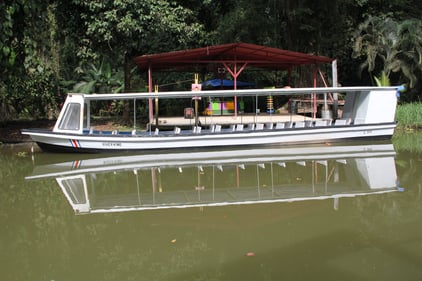
Across the 2026–27 season, Holland America is running a dozen Panama Canal voyages ranging from 14 to 21 days aboard Eurodam, Nieuw Amsterdam, and Zuiderdam, with departures from Vancouver, Seattle, San Diego, and Fort Lauderdale.
Neither experience feels like a compromise. The question is simply how far into the story you want to go.
Beyond the Locks
The canal may be the moment you talk about first when you get home, but it probably won't be the only one.
That's because Holland America's Panama Canal itineraries weave together places that rarely appear on the same vacation.
In Cartagena, you step inside a walled city of shaded plazas, colorful balconies, and streets that seem designed to make you miss your dinner reservation.
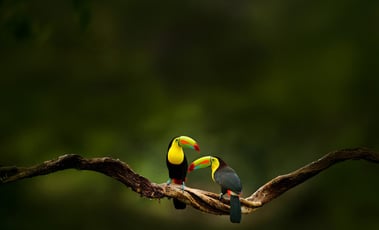
Costa Rica trades stone walls for rainforest. Toucans flash between branches, and sloths turn doing absolutely nothing into an art form. The landscape grows greener, louder, and increasingly difficult to photograph without eventually putting your phone away.
Along Mexico's Pacific coast, Huatulco opens into a collection of bays where the Sierra Madre meets the sea. Farther south, the ports of Chiapas and Central America pull you toward archaeological sites, local kitchens, and landscapes shaped by volcanoes and jungle.
And in Panama, you can leave the canal behind for a while. Travel by boat to an Emberá community, glide above the rainforest canopy, or return to the waterway itself from an entirely different perspective.
The journey keeps widening around you. What begins as a chance to witness one of the world's greatest engineering achievements becomes an exploration of several distinct corners of the Americas.
Why Now Feels Different
Travel has spent years getting faster. Shorter flights. Tighter itineraries. Three cities in seven days. A camera roll full of proof that you were somewhere, even if you barely had time to look around while you were there.
The Panama Canal asks something different of you.
Stand on deck.
Watch.
Wait for the gates to open.
You are not flying across a continent in a few hours. You are watching two oceans connect beneath your feet. And somewhere between one coastline and the next, you may realize the most memorable part of the trip was never a port at all.
It was the day your ship rose 85 feet into the rainforest.
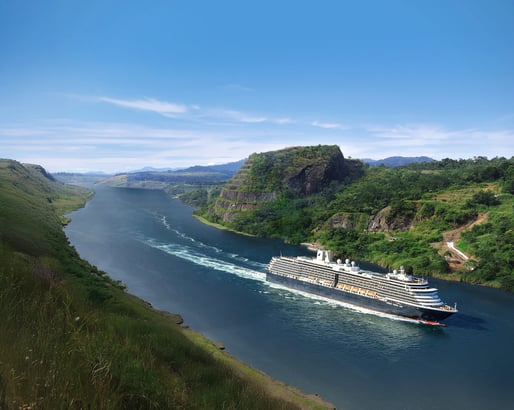
Whether you're drawn to a full coast-to-coast crossing or a shorter journey into the heart of the Panama Canal, we'll help you find the Holland America itinerary that fits your travel style.